the films of Tim Burton, animating live action in contemporary hollywood
Home               Reviews               Sample Chapter               Alison McMahan               Purchase
 

REVIEWS
The Films of Tim Burton, by Alison McMahan
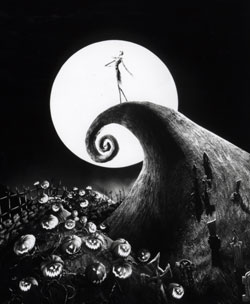
Nightmare Before Christmas still New York and London: Continuum 2005. 262pp, illus.
Hardcover: $85.00. Paperback: $21.95

I bet you didn't know that the last time you walked out of your multiplex, deflated from another bloated, plotless, loud, special effects extravaganza, you had just experienced something called pataphysical cinema. Such is Alison McMahan's claim in her book on Tim Burton. Going beyond the boundaries of a typical auteur profile, the book uses Tim Burton as a case study for understanding the Hollywood blockbuster and as a challenge to classical narrative film. McMahan writes that films like Burton's Batman (1989), Roland Emmerich's Independence Day (1996), or Stephen Sommers's Van Helsing (2004) are attacked by critics because they do not contain deep characterization, strong plots, or many of the elements that are traditional markers of quality. McMahan appropriates a manifesto from the College of Pataphysics-a French, post-war offshoot of the Surrealists and DADA, originally inspired by Alfred Jarry who coined the term a half century earlierÑin order to explain how these recent Hollywood films make meaning. According to her, these films make fun of established systems of knowledge, especially academic and scientific; follow an alternative narrative logic using special effects in self-conscious, blatant way; and feature thin plots and thinly drawn characters, relying on intertextual references from outside of the world of the story. Using an avant-garde movement to describe mainstream filmmaking is a counterintuitive and rather clever move. McMahan takes the elements of pataphysical art, however, without paying much attention to the political thrust of the artists who created it. This maneuver makes some sense when dealing with Burton, a Hollywood non-conformist whose films have definite affinities with the absurdist tradition. But his films, as well as the more conventional Hollywood films McMahan discusses, do not seriously undercut dominant modes of cinematic storytelling or parallel the modernist avant-garde art challenge to establishment views of theater and painting.

McMahan believes that directors have been getting pataphysical since the magician, Georges Méliès, first began to make his trick films at the turn of the century. In addition to the legerdemain and spectacle of early cinema, McMahan cites animation and video games as mainstream examples of alternative storytelling strategies that are antecedents of (or relate to) the pataphysical esthetic. Digitization and the increasingly large role of computer-generated imagery have blurred the lines between animation and live action. McMahan makes the point that pre-cinematic entertainments were a form of animation and that one could view the entire history of photographed cinema as a subset of the larger story of animation. The anarchic, abstract and gag-driven narratives of cartoons and other animations serve as a model for pataphysical directors. Burton, whose films traverse the line between animation and live action and freely mix genres and tones, is a perfect subject for McMahan.

Burton began his career as an animator for Disney after having attended the animation program at California Institute of the Arts, a school founded by Walt Disney for the expressed purpose of replenishing the talent for his highly profitable and successful cartoon studio. But Burton's quirky, gothic-comic style, infatuation with the morbid, and love of old horror films did not fit well with the Disney sensibility. After working on several different projects including artwork on The Black Cauldron (1985), he produced two highly accomplished short films, the animated Vincent (1982) and live action Frankenweenie (1984). The former was a 3-D stop-motion tribute to Vincent Price, about a young boy obsessed with the actor. The latter also focuses on a young man from the suburbs inspired by 1930's horror. After his dog is killed in a car accident, the hero reanimates his pet to the horror of his parents and neighbors. Although the film has a happy ending, it roughly follows the plot and visual style of James Whale's 1931 Frankenstein. Disney did not have much use for the films and neither was distributed. Burton was understandably miffed by the studio's decision and eventually made his feature debut, Pee-Wee's Big Adventure, in 1985 for Warner Brothers.

In Vincent and Frankenweenie, McMahan sees the prototypes for Burton's pataphysical feature filmmaking. Both films feature skeletal narratives that are structured around set pieces or gags, both mock suburban conformism and pedestrian ways of thinking, and both films make much more sense and are much more resonant if the viewer is aware of the films and sensibilities which Burton references and celebrates. McMahan argues that Burton uses animation as his model for narrative, rather than a classical story arc with a psychologically motivated protagonist. She writes in great detail about his commitment to three-dimensional animation, his love for stop-motion and the memorable creations of Ray Harryhausen in Jason and the Argonauts (1963) and The Valley of Gwangi (1969) as well as many other films. Burton resisted the move to digital animation and greatly valued the specific charms of more handmade, personal effects. Some of the book's best assets are McMahan's brief, but thorough and cogent histories of various technical innovations in moving picture media. We learn not only about stop motion, but also about different two-dimensional forms as well the development and takeover of CGI after the success of Steven Spielberg's Jurassic Park (1993).

According to McMahan, Burton's films favor narrative structures that promote a self-conscious showcasing of visual effects and his anarchic plots are structured around set pieces or bravura sequences. It is difficult to understand, however, how this esthetic differs from the style of most comedies, which move from gag to gag, without heavily relying on a plot. Furthermore nearly all generic cinema could be said to be constructed around specific signature elements: musicals are often song and dance numbers, loosely held together by the thinnest of situations; Westerns often use nearly identical situations, characters, and plots to reach some permutation of the cathartic gun fight at the end, and so on. While McMahan claims that pataphysical films have always existed and that she is not claiming that they are something new, she was, for me at least, unable to articulate what the term ÒpataphysicalÓ adds to writing that has already been done about comedy and understanding genre in terms of the excess of narrative.

The book's centerpiece is her discussion of Burton's Batman and Batman Returns (1992). McMahan argues that Batman was the birth of the modern high-concept blockbuster, where an instantly recognizable and pre-sold premise, like a comic book hero, is used as the basis for a summer hit film. She writes that in, these films, Burton combines his animation esthetic with elements inspired by myths and fairytales. She traces the evolution of the character through comics, graphic novels and in the comic television series and how these are combined by Burton. The first Batman was pre-sold and hyped to a huge degree and each of his decisions, from casting Michael Keaton to redesigning the batsuit was greatly scrutinized. The Batman films did not have to have terribly complicated or compelling plots; the familiarity of the character, the exciting special effects, Anton Furst's amazing design, and the mythic nature of Batman's fight against evil are its selling points and the source of its meaning rather than a suspenseful story. McMahan reads the films as a completely sincere attempt on Burton's part to give new life to this comic book hero. She ignores many of his parodic and comic touches that undercut the seriousness of the graphic novel version of Batman and McMahan's reading of it as a modern myth or fairytale. Jack Nicholson's campy performance as The Joker and his unbelievably silly balloons, come to mind right away.

McMahan's last chapter follows up on her discussion of Batman, and the blockbuster based upon special effects and pre-sold concepts. The chapter includes analyses of directors Sommers (The Mummy films), Barry Sonnenfeld (The Addams Family and Men in Black series) and Emmerich (the 1998 Godzilla). In each case, there is an attempt to shoehorn the filmmakers into her argument without an acknowledgement of the difference among the films being discussed. While all are based upon special effects and familiar premises, the performers and scripts created quite different results. Most importantly, she attributes the often cold reception of these films by critics as a failure on the part of journalists to see beyond classical narrative, when it was more likely a reaction to the cynicism, lack of imagination, and economic calculations that are the true creative force behind awful films like Godzilla and Van Helsing. McMahan argues that because these films portray corrupt or incompetent scientists or government officials, or the destruction of landmarks and institutions that they subvert the establishment in some way. This is a most superficial and clichéd challenge - that has long existed in Sci-Fi films--with no real ideological teeth(perhaps, this is less the case since September 11). They are just one in a series of forgettable provocations, never meaningfully followed up or explored. Tellingly, the book fails to discuss Sam Raimi's Spiderman films, which are much more psychologically driven and do not fit McMahan's thesis. In addition, she also ignores a far more influential and pervasive form of the modern blockbuster that originates with Steven Spielberg and George Lucas. Today, the best examples are produced by Jerry Bruckheimer, who redefines the movie as a roller-coaster ride or video game. The selling points of these films are their fast pace and special effects rather than a pre-sold concept. Burton's slower and more deliberate tempo in Batman almost recalls a bygone era.

Taken as a whole, the book provides an in-depth study of Burton and his filmography, but with a very particular point of view. As a welcome gesture against classic auteurism, McMahan devotes an entire chapter to the composer Danny Elfman and his contribution to the director's overall style. Other collaborators are dealt with more briefly, though sadly less attention is paid actors and performance. She groups her discussions of individual films according to how they fit into the larger argument about pataphysical filmmaking. This is unfortunate, because her discussion of different films is unbalanced. In her chapter on non-pataphysical Burton films, she spends very little time on Ed Wood (1994), writing that it is simply a biopic. In comparison, she spends the majority of the chapter analyzing how Burton combined all of the previous versions of Planet of the Apes into his own version. She writes plot summaries of each of the films and spends a great deal of time analyzing the shifting power balance between apes and humans in each installment. She never gets to the most interesting and subversive elements of these films: the fluidity of the division between primate and human in Burton's Apes and the irrelevance of the idea of quality in the face of artistic inspiration and passion in Ed Wood.

Burton is both the strength and weakness of the book. On the one hand, McMahan does make a convincing argument that pataphysics offers an interesting way of looking at Burton's films. Burton's originality and unique vision, however, weaken her overall argument about big Hollywood blockbusters. The Batman films may be the only Burton films that solidly fall into this category. The most influential aspect of these films (from the point of view of making blockbusters) was that they were based on a pre-sold product and were heavily marketed before the films appeared. Burton was responsible for neither of these aspects. To compare the use of a known comic book character or sitcom to Burton's multiple allusions ranging from Universal Studios horror films, to Mario Bava, to German Expressionism, is tantamount to missing the point of Burton's filmmaking. The thin plots and recognizable characters in today's Blockbusters exist because these movies are made to be legible to a large international audience with varying levels of education and language skills and a huge array of cultural backgrounds. Burton's references and commentary are much more specific, dealing with the milieu in which he grew up and a very particular kind of film fandom.

While Burton's use of special effects call attention to themselves, they do so in a way that highlights their unreality, as in Beetlejuice (1988), Mars Attacks (1996), and even in Batman. In the majority of big summer films, the effects call attention to themselves to let you know how much was spent on the film and to highlight their realism. While I do not want to hold Burton up as being immune to the lures of big money filmmaking, it does appear that, even in his most potentially profitable projects, Burton makes choices that jeopardize the broadest possible acceptance of his films in favor of a more personal and quixotic style.

Trying to understand and explain the phenomena of modern blockbusters is a worthwhile enterprise, but McMahan pays too little attention to the material circumstances under which they are made. She sets up mainstream newspaper critics as straw men to knock over instead of referencing writers who have produced more nuanced readings of the films she discusses. Her research on contemporary films relies too heavily on DVD extras and secondary materials. I believe the book would have benefited from interviews with directors, producers and technicians to get a wider view of the conditions and economic pressures under which these films are produced. McMahan brings together many interesting elements and takes a highly original and creative approach. In the final analysis, even after my reservations about the more wide-reaching claims of the book, she provides insight into Burton's oeuvre and challenges readers with a serious esthetic reading of mainstream contemporary Hollywood filmmaking.

- Rahul Hamid


Home               Reviews               Sample Chapter               Alison McMahan               Purchase
by Alison McMahan

